Get in Touch: info@xedos.ae

Cloud Attendance System vs On-Premise: Which Is Better for a UAE Business with Remote Staff?
A cloud attendance system beats on-premise for most UAE businesses with remote or hybrid staff. It costs less upfront, works from any location, and scales instantly as you add headcount. On-premise still suits businesses that want full physical control over server data or operate under strict internal data policies. Your choice should match your workforce structure and compliance needs, not just price.
Introduction
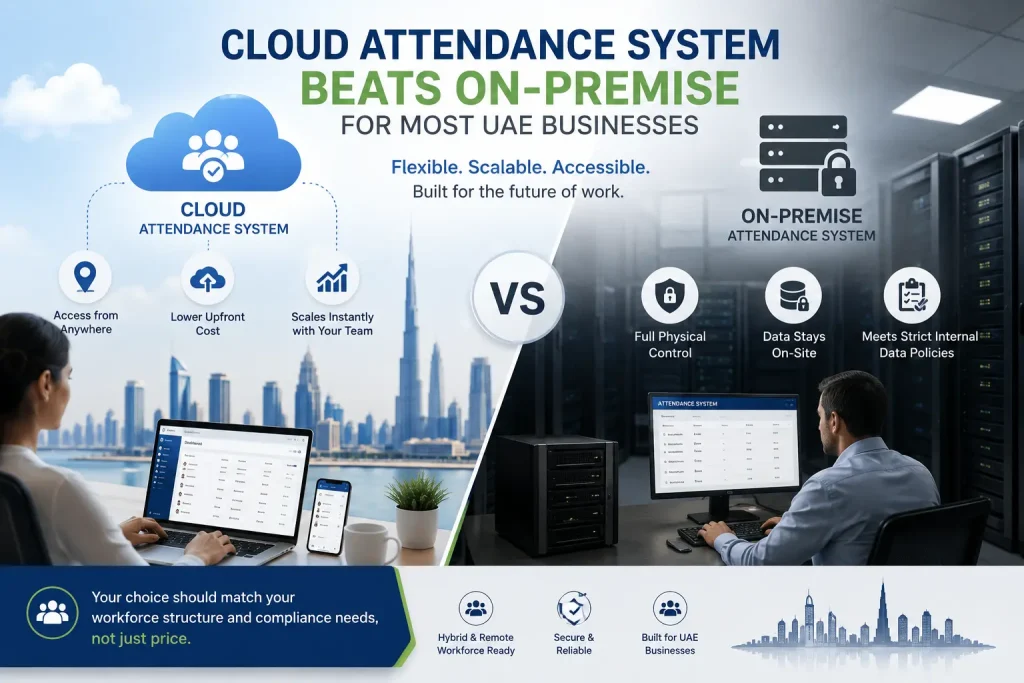
Nearly 90% of UAE professionals say they want hybrid or fully remote work going forward. That shift changes how businesses need to track attendance. A punch clock bolted to the office wall cannot see an employee logging in from home or a client site in Sharjah.
This is where the cloud versus on-premise decision becomes real. Cloud attendance systems run on remote servers and sync data over the internet. On-premise systems run on hardware you own and manage inside your office. Both track the same basic thing: who worked, when, and for how long.
But the right choice depends on your team structure, your IT capacity, and how UAE compliance rules apply to your data. This guide breaks down the real differences so you can make a decision that fits your business, not just a vendor’s sales pitch.
What’s the Difference Between Cloud and On-Premise Attendance Systems?
A cloud attendance system stores data on a vendor’s remote servers and is accessed through a browser or mobile app. An on-premise system runs on your own local server, inside your office, managed by your own IT team or provider.
With cloud systems, you pay a subscription and the vendor handles updates, backups, and server maintenance. With on-premise systems, you buy the hardware and software outright, and your team handles setup, security patches, and ongoing maintenance.
For attendance tracking specifically, this difference matters most in one area: access. Cloud systems let employees check in from a phone or laptop anywhere with internet. On-premise systems typically require a physical device, like a biometric fingerprint terminal, located at a fixed office location.
Which Costs Less — Cloud or On-Premise?
Cloud attendance systems cost less upfront because there is no hardware to buy. You pay a monthly or annual fee per employee instead. On-premise systems cost more initially due to server hardware, installation, and licensing, but may cost less over a long timeframe if you already have IT infrastructure in place.
Here’s how the cost structure typically breaks down.
Cloud attendance system costs:
- Monthly or annual subscription, usually priced per employee
- No server hardware to purchase
- Vendor handles updates and maintenance
- Lower setup time, often live within days
On-premise attendance system costs:
- One-time hardware purchase (biometric terminals, local server)
- Software licensing fees
- Ongoing IT staff time for maintenance and troubleshooting
- Higher upfront cost, but no recurring subscription fee
For a small or mid-sized UAE business, the cloud model usually wins on total cost. You avoid the capital expense of servers and free up your internal team from managing infrastructure. Larger enterprises with existing server rooms and dedicated IT staff sometimes find on-premise cheaper over a five-year window, since the sunk cost of infrastructure is already spent.
If your business already works with a managed IT services provider, ask them to model both costs against your actual headcount and growth plans before deciding.
Cloud vs On-Premise for Remote and Hybrid Teams
If your staff work outside a single office location, cloud attendance systems are close to a requirement rather than a preference. On-premise systems are built around a fixed physical location. A remote or field employee simply cannot check in on a server-bound terminal sitting in your Dubai office.
Cloud-based platforms solve this through mobile apps and browser-based check-in. Some UAE providers also use geofencing, which confirms an employee is within an approved location radius before allowing a check-in. This works well for field teams, sales staff, and hybrid employees who split time between home and office.
Xedos supports this through a geofencing attendance system that lets staff check in from approved zones using a mobile app, with real-time tracking for managers.
On-premise setups can technically support remote check-in through VPN access, but this adds complexity and depends on stable remote connectivity, something that adds IT overhead most SMEs would rather avoid.
Is Cloud Attendance Data Compliant with UAE PDPL?
Yes, cloud attendance systems can be fully PDPL-compliant, but attendance data involving biometrics needs extra care. The UAE Personal Data Protection Law classifies biometric data as sensitive personal data, which requires explicit employee consent and stronger security controls, regardless of whether it sits on a cloud server or a local one.
The PDPL does not generally require personal data to stay physically inside the UAE. Cross-border data transfer is allowed if the receiving country offers adequate data protection, or if contractual safeguards are in place. This means most reputable cloud attendance vendors, especially those hosting on UAE-based or GCC-region data centers, can meet PDPL requirements without issue.
What actually matters for compliance is not cloud versus on-premise. It’s whether the vendor encrypts data in transit and at rest, limits access to authorized personnel, and lets you fulfill employee data requests, like access or deletion, within the 30-day window PDPL requires.
If your attendance system also uses facial recognition rather than fingerprint or badge-based tracking, additional consent and Data Protection Impact Assessment obligations may apply. Our guide on facial recognition attendance systems covers those requirements in more detail if biometric device type, not deployment model, is your main decision point.
For deeper security assurance either way, pairing your attendance platform with proper cybersecurity services closes gaps that either deployment model can leave open.
On-Premise Attendance and UAE Labour Law Record-Keeping
UAE Labour Law, under Federal Decree-Law No. 33 of 2021, requires employers to keep accurate records of working hours, overtime, and leave. These records must be available for Ministry of Human Resources and Emiratisation inspection on request.
On-premise systems can meet this requirement, but the responsibility for backup and retention sits entirely with your business. If a local server fails or data is lost without a proper backup routine, you risk being unable to produce records during an inspection. That is a real operational risk, not just a technical inconvenience.
Cloud systems handle this differently. Records are automatically backed up and stored redundantly across the vendor’s infrastructure, which reduces the chance of losing attendance history to a single hardware failure. For a business that has faced MOHRE inspection stress before, this reliability difference is often the deciding factor over cost alone.
Either way, attendance records should also feed directly into your payroll and HRMS software to avoid manual re-entry errors that can trigger wage or overtime disputes.
Scalability — Which Grows Better with Your Business?
Cloud attendance systems scale faster because adding new employees or office locations requires no new hardware. On-premise systems require additional servers, terminals, and IT configuration each time you expand, which slows growth and adds cost at every stage.
This matters most for UAE SMEs expanding into new emirates or opening satellite offices. A cloud system lets you onboard a new location’s staff the same day, using existing mobile or web check-in. An on-premise system means ordering hardware, arranging installation, and configuring a new local server instance before that office can even use the system.
If your business plans to grow headcount or open new sites within the next two to three years, this scalability gap alone often justifies choosing cloud, even if on-premise looks cheaper on paper today.
How to Choose the Right Model for Your Business
The right choice comes down to three questions: how distributed is your workforce, how much in-house IT capacity do you have, and how sensitive is your compliance environment.
Choose cloud if:
- Your staff work remotely, hybrid, or across multiple sites
- You want lower upfront costs and fast deployment
- You don’t have a dedicated in-house IT team to manage servers
- You expect to grow headcount or add locations soon
Choose on-premise if:
- All staff work from a single fixed location
- You already have server infrastructure and IT staff in place
- Your organization has specific internal policies requiring local data control
- You operate in a sector with additional data localization mandates
Most UAE SMEs with any remote or hybrid staff land on cloud. Larger enterprises with existing infrastructure and single-site operations sometimes stick with on-premise, at least until their next infrastructure refresh cycle.
If you’re unsure which fits your specific setup, an IT consultancy assessment can map your workforce structure and compliance needs against both options before you commit budget.
Conclusion
Cloud attendance systems fit the way most UAE businesses actually work today: hybrid teams, multiple locations, and staff who expect to check in from wherever they are. Lower upfront costs, automatic backups, and instant scalability make cloud the practical default for businesses with any remote component. On-premise still has a place for single-location businesses with existing infrastructure and specific control requirements, but it comes with more ongoing IT responsibility.
Whichever model fits your business, getting the setup right the first time avoids costly rework later. Xedos Technologies has supported 500+ UAE businesses with attendance, payroll, and IT infrastructure decisions since 2013, and is a trusted UAE distributor for Anviz CrossChex Cloud, a web-based attendance platform that connects biometric hardware and mobile devices without needing a local server. Book a free consultation to get a recommendation tailored to your workforce and compliance needs.
Is a cloud attendance system safe to use in the UAE?
Yes, provided the vendor encrypts data in transit and at rest and meets PDPL requirements for sensitive personal data like biometrics. Look for vendors hosting on UAE or GCC-region data centers for added assurance.
Does UAE law require attendance data to be stored inside the country?
No, PDPL does not generally mandate in-country storage for standard employee data. Cross-border transfer is allowed if the destination country offers adequate protection or contractual safeguards are in place. Sector-specific rules, like those for health and banking data, are stricter.
Which cloud attendance system does Xedos recommend for UAE businesses?
Xedos is a trusted UAE distributor for Anviz CrossChex Cloud, a web-based attendance platform that connects biometric hardware and mobile check-in without requiring a local server. Contact Xedos for a setup recommendation based on your workforce.
What happens to attendance records if our on-premise server fails?
Without a proper backup routine, records can be lost permanently, creating compliance risk during a MOHRE inspection. Cloud systems back up data automatically across redundant infrastructure, reducing this risk.
Is on-premise ever cheaper than cloud in the long run?
It can be, mainly for large single-location businesses that already own server infrastructure and have in-house IT staff to maintain it. For most SMEs, ongoing maintenance costs offset the lack of a subscription fee.
Can a cloud attendance system integrate with payroll software already in use?
Most modern cloud attendance platforms integrate directly with payroll and HRMS systems, syncing hours and overtime automatically to reduce manual entry errors.